
Goats have been valued for their milk, meat, and coat for over 10,000 years but in recent years, a new and powerful role for these intelligent ruminants has emerged: environmental stewardship. Moving beyond the quaint image of a goat nibbling on a tin can with an old tire around its neck, land managers, municipalities, and environmental scientists are increasingly deploying herds of goats as a sustainable tool for vegetation management. This practice, known in various iterations as targeted grazing, browsing, and foraging, involves the intentional deployment of grazing goats (and sheep) at a specific location, season, duration, and intensity to accomplish defined vegetation management goals. It is a practice rooted in agroecology, blending traditional knowledge with modern ecological science. As RFTA celebrates its 10th year of goat grazing along the Rio Grande Trail, let us delve into the primary goals and benefits of RFTA’s goat grazing mission.
Noxious Weed Control: The Living Herbicide
The challenge of invasive and noxious weeds is an issue that negatively impacts ecosystems across the globe. Traditional control methods often rely on chemical herbicides and big machinery, which can be costly, face regulatory hurdles, and raise concerns about non-target flora and fauna as well as water quality. Goats are natural browsers with a digestive system and feeding behavior uniquely suited for weed control. Unlike cattle and sheep (which are primarily grazers of grasses), goats prefer broad-leafed plants, shrubs, and forbs—the very category that includes most noxious weeds like knapweed, thistle, dock varieties, and poison ivy. They do so through a series of innate behaviors and biological traits:
- Preferential Feeding: They actively seek out and consume these plants, often ignoring desirable native grasses and vegetation.
- Digestive Advantage: Many weed seeds are destroyed as they pass through the goat’s digestive system, reducing the seed bank in the soil.
- Mechanical Disruption: The act of grazing also stresses the plant, depleting its root reserves and preventing it from flowering and setting seed. Their hooves trample and disturbed weed seedlings, further setting back invasions.
Soil Improvements: The Unseen, Yet Long Term Benefit
While some benefits of goat grazing are highly visible, one of the most significant advantages takes time to develop and occurs beneath the surface: soil enhancement. Goats contribute to soil health in several profound ways including nutrient recycling, improving soil structure, and fostering natural irrigation. As goats consume plant biomass, they return a majority of those nutrients to the soil in their readily available and abundant organic manure. This acts as a natural fertilizer, boosting microbial activity and soil fertility. Their hooves gently incorporate this manure and trample existing biomass into the soil surface, aiding in decomposition and increasing organic matter content through aeration and natural fertilization. Increased organic matter improves soil structure, creating pore spaces that enhance water infiltration and retention. This reduces stormwater runoff and erosion, making the land more resilient to both drought and heavy rain. The overall soil health and stability initiated by goat grazing, especially over the long term, is one of the most impactful benefits of the practice.
Clearing of Waterways: Stabilizing and Restoring Riparian Zones
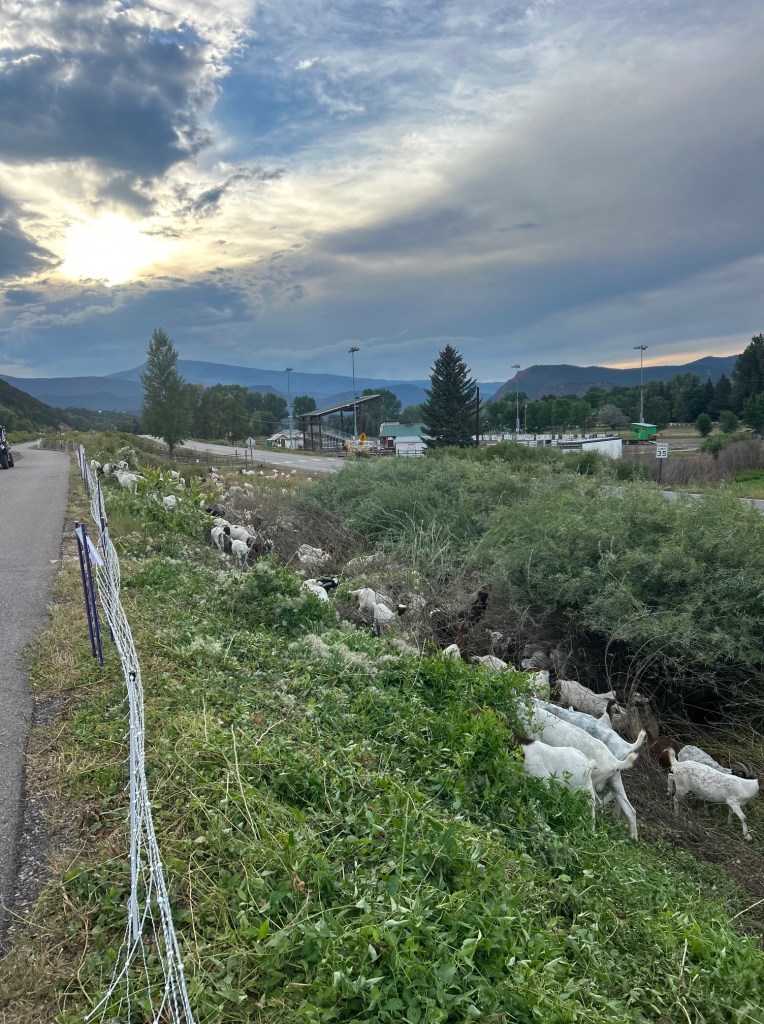
The Rio Grande Trail supports an eclectic assemblage of plants and animals due to numerous factors, including the availability of water through irrigation canals and the proximity of the Roaring Fork River. The maintenance and protection of the associated riparian zones—the areas adjacent to streams and rivers—are vital to the ecosystem as they filter pollutants, prevent erosion, and provide invaluable habitat. These areas, however, are often choked with heavy vegetation, both native and noxious, which can impede water flow and degrade habitat quality. Using machinery in these sensitive areas is often prohibited due to the risk of compacting soil, causing bank erosion, disturbing aquatic life, and, in the case of the Rio Grande Trail, heavy auto, bike, and pedestrian traffic. Goats offer a nimble and low-impact alternative while providing the following benefits:
- Low-Impact Access: Their small hooves exert less pressure on the ground than heavy machinery, minimizing soil compaction and bank collapse.
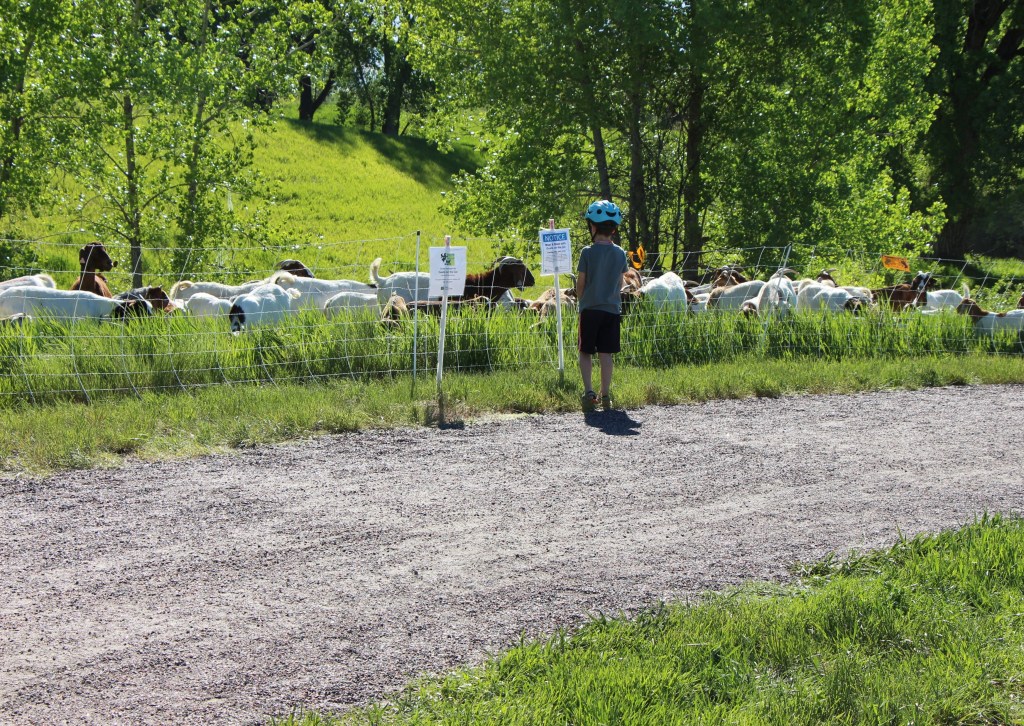
- Precision Clearing: They can be strategically herded with temporary electric fencing to target specific invasive thickets, opening up the canopy for native willow, sedge, and other riparian plants to re-establish.
- Nutrient Cycling: Their manure returns nutrients to the soil in a natural, slow-release form, fostering healthier plant growth without the chemical runoff associated with fertilizers.
Conclusion: A Synergistic Solution
Targeted goat grazing is not a silver bullet, and it requires skilled herders to manage timing, density, and duration to achieve the desired outcome. It does, however, represent a powerful shift towards working with natural processes rather than against them. By leveraging the innate behaviors of the goat, we can address multiple ecological challenges simultaneously, while specifically targeting RFTA’s overarching vegetation management goals. It is a solution that is not only effective and sustainable but also reduces chemical inputs, supports local agriculture, and provides a captivating reminder that sometimes, the best technology for the job is a biological one. The humble goat, it turns out, is a sophisticated ecological engineer in disguise that Rio Grande Trail users can enjoy.
 Goats On The Go Boulder
Leave a comment